Is Tarot Easy to Learn? Yes. If You’re Taught the Right Way
The Tarot Question Every Beginner Asks
Is tarot easy to learn? It’s one of the most common questions I get as a professional tarot reader and tarot teacher – and the honest answer might surprise you. Tarot is not difficult. But whether it feels easy or overwhelming depends almost entirely on how you are taught.
Let me share a story that changed the way I teach tarot forever.
When Good Tarot Teaching Goes Wrong
I have been the only Tarot reader in my friends circle. So, you can imagine my great joy when one of my close friends decided to learn Tarot. She spent over a month with every free moment attending long half-day or in some cases full-day tarot classes. I visited her one day after she had completed her course and was very excited to ask her to pull some cards and do a reading for me. I was shocked that she wasn’t able to interpret the two cards.
I then asked her how it was that she had attended so many tarot classes and still wasn’t able to read a simple two- or three-card spread. She said that her teacher, who is one of the most prominent teachers in the country, teaches tarot through storytelling. She spent so many hours listening to a storytelling method of explaining each card and I realized that the root of the problem was that the teacher was teaching through her own stories. To her each story was personal, and had great meaning and was easy to recollect. It was a third-party story to her students. I was horrified and offered my friend a very short, quick explanation of the cards. I took about 45 minutes, and very quickly ran through the cards for her. She told me that at the end of those 45 minutes she had learned more from me than she had learned in her entire tarot course. This motivated me to offer my own tarot course.
This experience confirmed something I had always suspected: the method of teaching tarot matters far more than the number of hours spent studying it.
Why Most Beginner Tarot Courses Fail Students
Many tarot courses — even those run by well-known teachers — rely on memory-heavy methods: lists of card meanings, lengthy folklore, or personal storytelling that only resonates with the person telling the story. For a beginner trying to build their own tarot practice, this approach leaves a huge gap between learning and actually reading.
If you’ve tried to learn tarot before and felt like you “just couldn’t get it,” it’s very likely not you — it’s the method.
The good news? There is a far more logical way to learn tarot card reading, and it’s built right into the cards themselves.
The Reasons Why I’ve Structured My Tarot Course the Way I Have
Easy Ways of Understanding the Tarot System
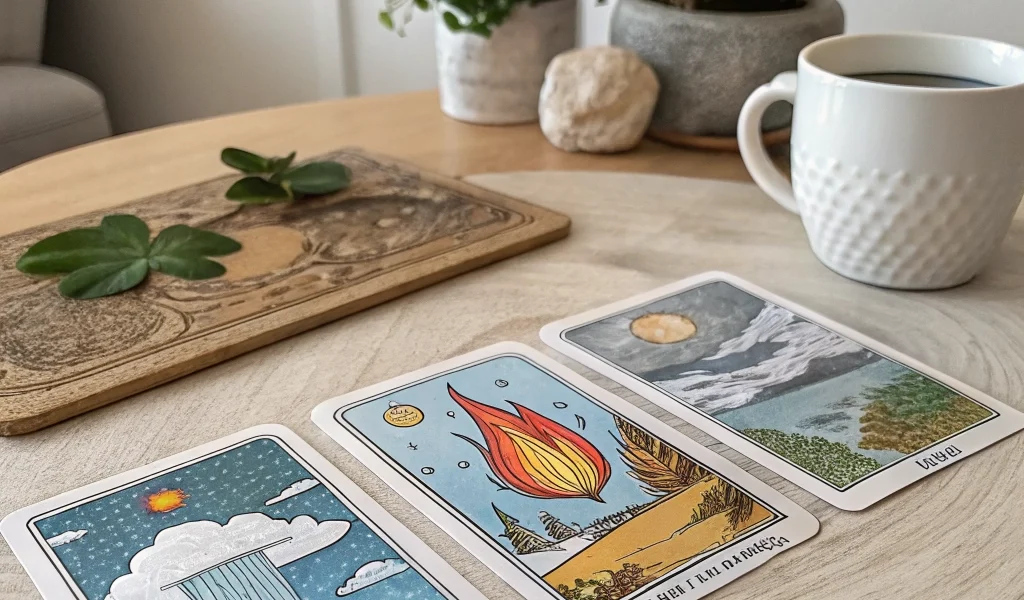
I firmly believe that Pamela Coleman-Smith has done the world a huge favour by adding so many visual cues to interpretation. That way one has everything that one needs to interpret a card right there on the card. Even without going deep into tarot symbolism, the emotion, the movement, the gestures, the specific items on the card give you clues to great interpretation without memorisation.
This is the foundation of how I teach: you already have all the information you need, right in front of you. The Rider-Waite-Smith tarot deck was designed precisely so that intuitive reading would be accessible to everyone willing to look.
Reading the Visual Cues in Tarot Cards
The problem with not being taught tarot the way I have learnt it and been taught it is that one does not gain the confidence to read the visual cues. When I teach the tarot, I unlock those visual cues and many of my students are just so amazed that it’s actually quite simple. It’s just that they didn’t know what to look for and how to relate it. Once you’re able to relate certain things to certain meanings, it’s pretty easy to interpret a card.
Think of it this way: a card showing a figure with hunched shoulders, eyes downcast, and heavy rain falling tells you something immediately, without a single keyword. Learning how to look is the real skill — and it’s one that anyone can develop.
Tarot and the Four Elements
I have come to tarot from an astrology background so interpreting elements comes very easily to me. However I don’t teach students how to interpret elements and different aspects of them. When you combine the visual cues with the elements and the numbers of the cards, it is incredibly easy to understand the tarot.
For those curious: each suit of the Minor Arcana is linked to one of the four classical elements — Wands (Fire), Cups (Water), Swords (Air), and Pentacles (Earth). These elemental associations carry the emotional and energetic qualities of each suit, adding another layer of meaning that sits right on the surface of the imagery.
Learning the Basics of Tarot Without Memorisation
I fully believe that a student of tarot must first understand the basics, like I said, without memorization, simply by listening very carefully to the teacher and understanding what to look for. They should then spend many hours on self-study by sitting and visually examining each of the cards so that they fully imbibe the feeling, the energy, and the message that each card is telling them in isolation. I also recommend Daily Draws. I actually have a group where all of my students pull cards every day and give their interpretation and at the end of the day they tell us how the day played out. This exercise helps with constant practice, which builds the “muscle memory” that one needs for Tarot. Even though I teach a few meanings and every book would teach a handful of meanings, I believe that this daily exercise helps every student add to their own vocabulary of Tarot.
Daily draws are genuinely one of the most powerful tools for any beginner tarot reader. They move you from theory into lived experience very quickly, and that personal experience becomes your most reliable reference.
What You Can Expect to Learn in a Good Tarot Course
A well-structured tarot course for beginners should cover:
- How to read tarot card imagery intuitively — without relying on memorised lists
- The structure of the tarot deck — the 22 Major Arcana cards and the 56 Minor Arcana cards
- The four suits and their elemental meanings
- Numerology in tarot — how the numbers 1 through 10 carry consistent energy across all suits
- Simple tarot spreads — from a single-card daily draw to three-card spreads for past, present, and future
- How to do a tarot reading for yourself and others with confidence
So, Is Tarot Easy to Learn?
Absolutely tarot is a very direct, easy-to-learn system without any memorization. You just have to access it without fear, with an open mind, and then practice makes perfect.
The 78 cards of the tarot are not a system to be feared or spent years memorising. They are a visual language — and like any language, the more you immerse yourself in it, the more fluent you become. The right teacher simply shows you the grammar.
Ready to Learn Tarot the Right Way?
If you’ve been wondering whether tarot is too complicated, too mystical, or too much to take on — I’m here to tell you it isn’t. My tarot course is designed specifically to get you reading cards confidently, using visual cues, intuition, and daily practice rather than rote memorisation.
Whether you’re a complete beginner or someone who has tried to learn tarot before and felt lost, I’d love to show you how approachable this beautiful system really is.
Looking to go deeper? I also offer astrology readings, astrology courses, and Lenormand card readings. Explore all the ways we can work together.